

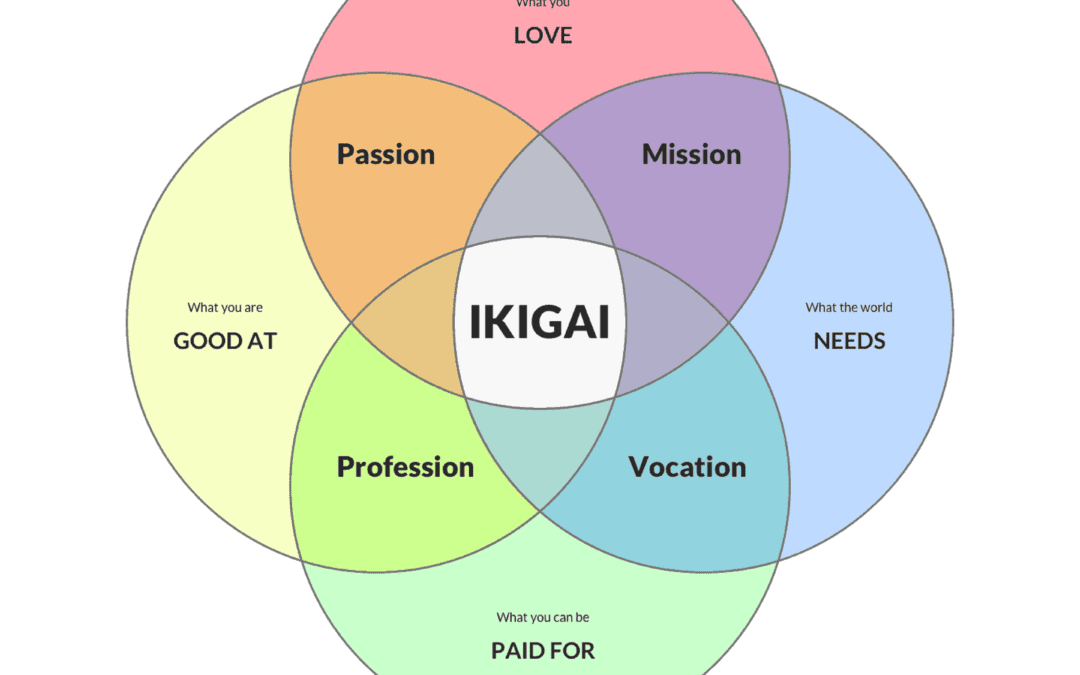
How can you increase your overall satisfaction with life? The Japanese have a concept called IKIGAI, which translates as your reason for being. The IKIGAI diagram provides a useful template to explore your satisfaction in four categories. You can quickly identify which aspects of your life are not delivering fulfilment.
The Power of the IKIGAI Diagram
- What you love
- What you’re good at
- What the world needs
- What you can be paid for.
Which areas of your life deliver currently against each category? Where do they intersect?
Why So Many of Us Feel Unfulfilled
Many people find themselves dissatisfied because they only focus on two or three IKIGAI dimensions.
Take my own experience of work. My first job ticked just one box: what I could be paid for. During a recession, I took a telesales role out of necessity. I dreaded Monday mornings, counted the hours each day, and felt utterly drained by Friday. I wasn’t good at it, and the world didn’t need another reluctant telesales worker.
Eventually, I retrained—and everything changed. My new career aligned with all four elements of IKIGAI: Profession, Passion, Vocation, and Mission. For the first time, I loved what I did, felt I mattered, and was using my strengths for something meaningful. It was transformational.
Later, I moved into another role, one that paid well and matched my skills but lacked a sense of mission. A friend observed that I was “hitting the target but missing the point.” That phrase struck a chord. I realised I’d drifted away from my own IKIGAI—and soon after, I made another change. My sense of energy and purpose returned instantly.
My decision to move into self-employ means I’ve been able to shift my focus to what I’m good at and enjoy and less on activities that drain me.
Asking the Right Questions
When exploring career options, the key is to reflect deeply on what each dimension means to you. That’s where the intersections on the IKIGAI diagram are key.
- Profession: What am I good at, and what can I be paid for? You might succeed on paper, but will it energise you, or slowly drain your battery?
- Mission: What do I love, and how does it serve the world? Can this path also sustain me financially and make use of my skills?
- Vocation: What does the world need, and will it also pay me? Do I have the right skills and will I enjoy the work?
- Passion: What do I love, and what am I naturally good at? But can it also support me? Is it something that others need or want? (This may not matter unless you need your passion to pay you).
Sometimes, aligning three of these four elements can still bring real contentment—certainly more than many experience today. But when you find something that brings all four into harmony, that’s when work stops feeling like work.
Building a Life Worth Waking Up For
There’s no overnight formula for finding your perfect job. Everyone’s concept of fulfilment is different. But using the IKIGAI framework gives you a clear lens through which to evaluate your options—not just what you can do, but what you’re meant to do.
Wider life applications
My example only focuses on work. However, the Japanese apply the concept as a way of living. It may not be realistic for paid employment to deliver against all four categories. You will have absorbing interests, talents, family and friends that deliver on what you love and what you’re good at. Volunteering may deliver for you on what the world needs.
Finding your IKIGAI isn’t about chasing perfection—it’s about designing a life which feels like an expression of who you are.
Ikigai translated into English as ‘life purpose’ sounds quite formidable, but ikigai need not be the one overriding purpose of a person’s life. In fact, the word life aligns more with daily life. In other words, ikigai can be about the joy a person finds living day-to-day, without which their life as a whole would not be a happy one.
Aikihiro Hasegawa Associate Professor – Toyo Eiwa University