
In a previous post, I explored the idea of reflecting on our childhood influences. The games, toys, stories, and role models that quietly shape us and often continue to steer our career choices long after we’ve forgotten them.
What I didn’t expect was how difficult it would be to apply the same exercise to myself. It’s funny how easily we can spot patterns in other people’s lives, yet struggle to recognise the ones woven through our own.
At first, nothing obvious appeared. And then, slowly, something surfaced, as if my subconscious had been quietly working away in the background. When it finally clicked, it felt obvious. The pattern had been there all along.
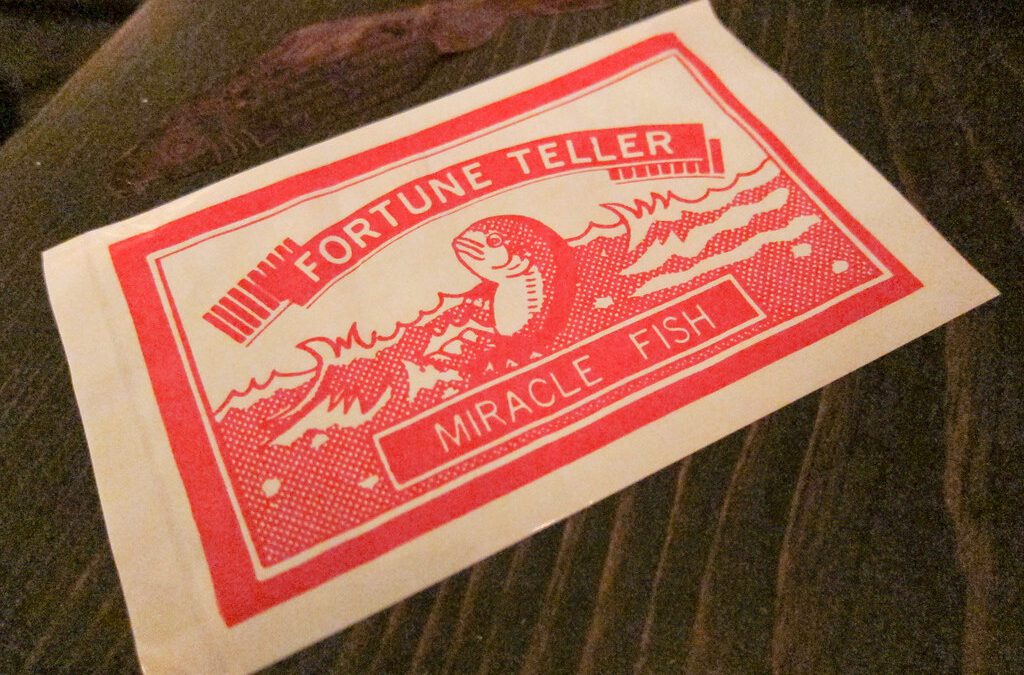
The fortune-telling fish
As a child, I was irresistibly drawn to anything that promised a glimpse beneath the surface; any tool that hinted at hidden meaning or inner truth. At Christmas, I was always delighted if my cracker contained the fortune‑telling fish. The flimsy red cellophane, curling and twisting in my palm felt like magic. Each movement supposedly revealed a different emotion. I was captivated.
The origami colour changer
I loved making origami colour-changers too. I’d ask friends and family to choose a colour, then a number, before dramatically revealing their “fate.” It was part game, part ritual, part attempt to understand something about them.
It’s in the stars
In my weekly copy of Jackie magazine, I always turned straight to the horoscopes. I wanted to know what the stars had in store for Geminis. I even had a brief flirtation with the occult and Ouija boards. More curiosity than conviction, but the fascination was real.
Tarot cards and other signs
This curiosity followed me into my twenties, when I bought my first pack of Tarot cards. I hadn’t told a soul, yet that very day I overheard a colleague mention someone who ran courses on reading Tarot cards. It was clearly a sign, so I signed up for an eight‑week class.
For a while, I practised enthusiastically on friends and acquaintances. Occasionally I revealed things I couldn’t possibly have known, or predicted events that later unfolded. For example, a lost job, a partner’s betrayal. It unnerved me (and others), and eventually the cards were tucked safely away in a drawer.
The I Ching, an ancient Chinese divination system, offered fewer direct answers but plenty of reflection. It encouraged me to look at situations from different angles, to consider possibilities I might otherwise have missed.
What did all this reveal about my career?
Early in my working life, I spent a miserable year in an employment agency. My job was to match people to roles, whether they were a good fit or not , simply to meet targets. It felt wrong. I knew I wanted to help people find work that genuinely suited them, not push them into roles that didn’t.
Careers work seemed to offer the opposite experience, and luckily, it did.
Tools for insight
Once I moved into careers work, I found myself drawn — unsurprisingly — to tools, cards, questionnaires and profiles that promised insight. I embraced them all with the enthusiasm of a child in a sweet shop:
JIIG CAL, CASCAID, Prospects Planner, Morrisby, Strengths, RIASEC, Schein’s Career Anchors, Values, Motivations, IKIGAI, MBTI, 16PF, the Big Five, DISC… Many of these have found their way into my work with students and clients over the years.
Bookshelves as evidence
A glance at my bookshelves tells the same story: self-help, popular psychology, reflective exercises, guides to overcoming limiting beliefs. My reading habits echo the same early fascination; a desire to understand what lies beneath the surface.
The thread running through it all
At its heart, my motivation for careers work has always been simple: I want to help people answer the question “Who am I?” When people understand their strengths, values and motivations, they’re better equipped to choose work that allows them to flourish. Self‑knowledge makes decision‑making easier, more authentic, and more grounded.
I’m the first to admit that no questionnaire or profile can fully answer that question. But they can illuminate parts of ourselves we might not otherwise recognise or appreciate.
And in my case, they reveal something else. That my childhood fascination with understanding myself, has quietly evolved into a lifelong interest in helping others understand themselves.